Transit Expansion to Counter Population Decline
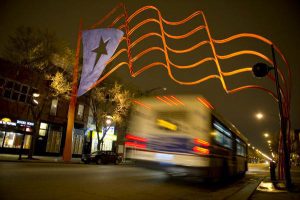
Bus passing under the flag statue on Paseo Boriqua
Ann Hermes/The Christian Science Monitor/File
From 2000 to 2010, Humboldt Park lost about fifteen percent of its population. Humboldt Park had about seventy-seven thousand residents in 2000; in 2010, it had about sixty-five thousand residents. Of course population decline occurs for various reasons, but it is troubling that this trend is continuing–the American Community Survey estimates Humboldt Park is now home to a little more than sixty-three thousand residents.
While many other centrally located neighboring areas are growing, Humboldt Park is declining. This can be attributed in part to changing demographics within the community, along with the nation-wide trend of lower birthrates. However, other neighborhoods with better access to public transportation to the north and east like West Town and Logan Square are growing, at least in total number of available housing units. What do these neighboring communities have that Humboldt Park doesn’t? Fast and reliable transit.
Most Humboldt Park residents who use transit daily agree that it is difficult to get around the neighborhood and city when relying solely on slow moving and unreliable buses. David Ramirez, who lives west of the Park, says that taking buses to get to his job near the Illinois Medical District isn’t convenient; he instead has to drive to work. “Driving is expensive, but the bus takes way too long. When my car broke down last summer, I had to take it and it would take me like an hour. Driving never takes more than a half hour.” Many people prefer to take public transportation because of the lower cost and avoidance of traffic. Often, this is not possible in neighborhoods around the city–even those in relatively close proximity to the Loop.
Though not all rapid-transit linked neighborhoods in the city are experiencing growth, communities to the north and east of Humboldt Park are seeing population increases. While many factors helped contribute to this adjacent growth, CTA Blue Line service has undoubtedly played a large role. Some areas south of Humboldt Park have also enjoyed modest growth partly dependent on CTA Green Line service.
In Humboldt Park, bus ridership has declined across all eight routes serving the neighborhoods over the last several years. Individual boarding data is not available for each stop, but one can assume that a decrease in route-wide ridership illustrates a decrease in ridership within a given community. Bus ridership is down throughout Chicago, but L ridership is growing significantly. Logically, ridership numbers are highest in areas experiencing population growth. If Humboldt Park had a rapid transit link to the rest of the city, it might be able to attract an influx of residents. The CTA tore down the Humboldt Park Branch of the L a long time ago and likely will never restore it–but there are other methods to increasing transit speed and reliability without the immense capital investment of heavy rail.
Rendering of CTA’s Ashland BRT Route
John Greenfield/Streetsblog Chicago/File
Bus rapid transit could be the answer. Though BRT has been contested recently in Chicago, other cities have proven that a full BRT system with traffic-signal prioritization, pre-boarding at spaced-out stations, dedicated right-of-ways, branding, and other amenities can be a wildly successful transit enterprise.
In 2011 the Metropolitan Planning Council released a report titled “Bus Rapid Transit: Chicago’s New Route to Opportunity.” It analyzed the feasibility and need of several routes for BRT recommendations, including North Avenue from Western to Harlem, and Western Avenue, from Howard to 95th. Ultimately, North Avenue didn’t make the report’s final recommendations because it didn’t meet each of the MPC’s criteria. However, if a BRT line was built along North Avenue, it could provide a boon to the Humboldt Park economy.