Northwest Food Partners Network Advocates for Community Food Security
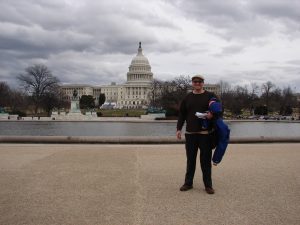
Earlier this month, amidst intense budget debates, anti-hunger advocacy groups Feeding Illinois and Feeding Americaheld conferences in Springfield and Washington DC, emphasizing the importance of government support for building local food security. Northwest Food Partners Network (NFPN) coordinator and co-chair of operations Daniel Pasquini-Salazar from La Casa Norte was selected by the Greater Chicago Food Depository to represent area districts at the conferences.
The overall message to legislators both in the ‘Land of Lincoln’ and on Capitol Hill was clear and simple – ‘do not balance the budget on the backs of our most vulnerable citizens, especially those struggling against hunger.’
A recent USDA study shows that close to 1 in 7 Americans are classified as food insecure, or in other words, have difficulty obtaining sufficient quantity and quality of food. A community food survey conducted by the NFPN last October suggests that food insecurity in Humboldt Park may be effecting as many as 1 in 2 residents. Food pantries nation wide have seen a tremendous increase in demand since the economic recession hit in 2008, and several studies show that Latinos have suffered the largest increase of food insecurity of any ethnic group.
In Springfield the group met with State Senators Willie Delgado (2nd) and Iris Martinez (20th) and State Representatives Cynthia Soto (4th) and Toni Berrios (39th) to talk about the state budget’s impact on food assistance programs and community food security. The SNAP program (formerly known as food stamps) was a hot topic of disscussion at the meetings. Currently, there is a push by state Republicans to place more requirements on people applying for SNAP benefits, making the process even more difficult. As documented in the book All You Can Eat: How Hungry is America? by Joel Berg, to aquire SNAP benefits (at most a few hundred dollars per month, often less) families must go through a more rigorous application screening than someone applying for farm subsidies that could cost hundreds of thousands annually. These types of systemic injustices are what NFPN advocacy efforts want to change.
At the state level, anti-hunger advocacy has had an important impact with the formation of the new Illinois Commission to End Hunger with Governor Quinn naming community resident/leader Juanita Irizarry as a member.
In Washington the advocacy group met with staffers of Senators Dick Durbin and Mark Kirk, as well as, House Representatives Luis Gutierrez (4th) and Mike Quigly (5th). In the House of Representatives the first budget proposal (bill HR 1) would drastically cut federal funding for food assistance programs, effecting mostly seniors and children. Direct service providers from Chicago food pantries and social service agencies gave testimonials about how the federally funded food programs help their clients who are struggling with decisions between paying for food or medicine, or, adequate meals for children or heating the house.
In this era of bank bailouts and tax breaks for the ultra-rich, low income families are being made to bare the brunt of government debt – this is evidenced by the proposed cuts to the food assistance programs and many other social safety net programs. The NFPN knows that part of the work of building food security in our communities is advocating for policies and programs that are successful in closing the hunger gap. The trips to Springfield and Washington DC have allowed for our voices to be heard in the halls of power, making legislators aware of the realities facing our communities in Chicago and pressuring them to respond equitably.
If you are interested in helping build food security with the NFPN, please contact Daniel Pasquini-Salazar at daniel@lacasanorte.org.